Oral-Motor Skills in Autistic Children: Why Eating and Speaking Can Be Challenging

Children with autism often face unique developmental challenges, and among the most common are difficulties related to eating, chewing, swallowing, and speaking clearly. These challenges are closely connected to something known as oral-motor skills.
Understanding oral-motor development can help parents recognize early signs of difficulty and support their child with the right exercises, therapy, and daily activities.
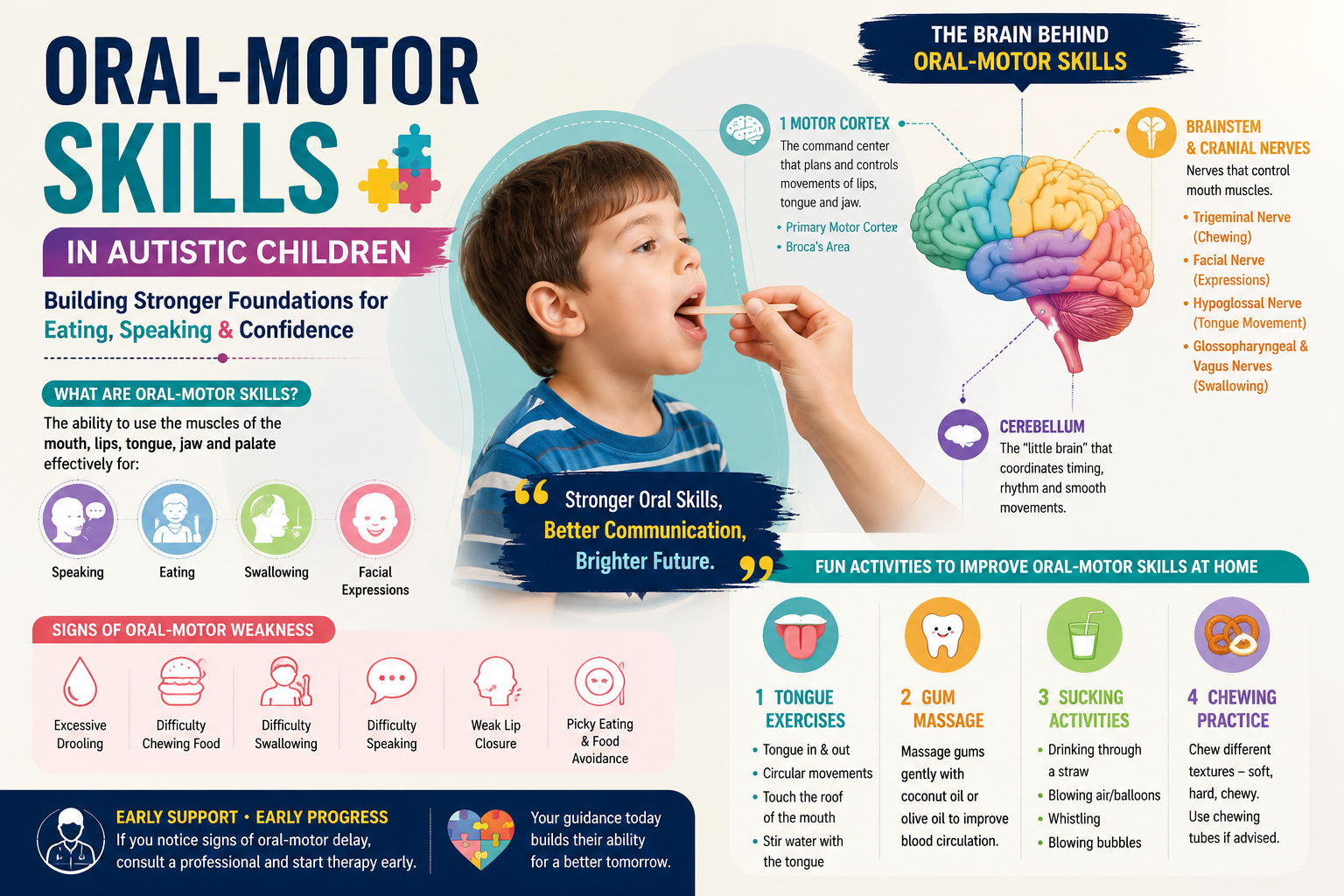
What Are Oral-Motor Skills?
Oral-motor skills refer to the ability to properly use the muscles of the:
- Mouth
- Lips
- Tongue
- Jaw
- Palate (roof of the mouth)
These muscles work together to help us:
- Eat and drink
- Chew food
- Swallow safely
- Speak clearly
- Smile and express emotions
In autistic children, these skills may develop differently due to differences in brain processing, sensory responses, and muscle coordination.
Types of Oral-Motor Skills
1. Eating & Drinking Skills
These skills help children manage food and liquids safely.
They include:
- Chewing (mastication)
- Tongue movement
- Lip closure
- Swallowing coordination
Children with oral-motor difficulties may struggle to chew properly, move food around the mouth, or swallow comfortably.
2. Speaking Skills
Clear speech depends on precise muscle coordination inside the mouth.
Important speaking skills include:
Articulation
The tongue, lips, and jaw work together to pronounce words correctly.
Breath Coordination
Controlled airflow helps produce speech sounds such as:
- “Pa”
- “Ba”
- “Pha”
Weak oral muscles can affect speech clarity and pronunciation.
Signs of Oral-Motor Weakness in Autism
Parents should watch for signs such as:
- Excessive drooling
- Difficulty chewing food
- Trouble swallowing
- Delayed speech development
- Unclear pronunciation
- Weak lip closure
- Food pocketing inside the cheeks
- Avoiding certain food textures
Early identification is important because oral-motor delays can affect both nutrition and communication skills.
How the Brain Controls Oral-Motor Skills
Several parts of the brain work together to control eating and speaking.
1. Motor Cortex – The Command Center
Located in the frontal lobe, the motor cortex controls voluntary muscle movements.
Primary Motor Cortex
Sends movement instructions to:
- Lips
- Tongue
- Jaw
Broca’s Area
This area plans speech movements.
For example, before saying “Hello,” the brain decides:
- How the tongue should move
- Where the lips should position
- Which muscles should activate first
2. Brainstem & Cranial Nerves
The brainstem contains important nerves that directly control mouth muscles.
Trigeminal Nerve
Controls jaw movement for chewing.
Facial Nerve
Controls:
- Facial expressions
- Lip movements
- Smiling and blowing
Hypoglossal Nerve
Controls tongue movement and coordination.
Glossopharyngeal & Vagus Nerves
Help manage swallowing safely.
3. Cerebellum – The Coordination Center
The cerebellum is often called the “little brain.”
Its job is to coordinate:
- Timing
- Rhythm
- Smooth movements
For example:
- Coordinating chewing movements
- Preventing accidental tongue biting
- Managing speech timing
How Oral-Motor Processing Works
Let’s understand with a simple example:
When a child eats food:
- The sensory cortex identifies where the food is inside the mouth.
- The motor cortex instructs the jaw to chew.
- The brainstem nerves activate the mouth muscles.
- The cerebellum coordinates smooth chewing and swallowing.
If any part of this process is weak or delayed, the child may struggle with eating or speaking.
Home Activities to Improve Oral-Motor Skills
Parents can support oral-motor development through simple daily exercises.
1. Tongue Exercises
These help improve tongue strength and coordination.
Try:
- Moving the tongue in and out
- Rotating the tongue inside the mouth
- Touching the roof of the mouth with the tongue
- Moving water around inside the mouth
2. Gum Massage
Gentle gum massage may improve oral awareness and circulation.
Use:
- Coconut oil
- Olive oil
Massage gently using clean fingers.
3. Sucking & Blowing Activities
These strengthen mouth and throat muscles.
Activities include:
- Drinking with a straw
- Blowing bubbles
- Inflating balloons
- Whistling
- Blowing air through a straw
4. Chewing Practice
Introduce foods with different textures:
- Soft
- Crunchy
- Chewy
You can also use:
- Chewing tubes
- Oral sensory tools recommended by therapists
When Should You Seek Professional Help?
Consult a pediatrician, speech therapist, or occupational therapist if your child shows:
- Persistent drooling
- Severe speech delay
- Difficulty swallowing
- Choking while eating
- Extreme food selectivity
- Weak jaw or tongue movement
Early therapy and intervention can significantly improve eating, speech, and overall communication skills.
Final Thoughts
Oral-motor difficulties in autism are not simply “bad habits” — they are connected to how the brain, nerves, muscles, and sensory system work together.
With patience, therapy, and supportive activities at home, many children can develop stronger eating and speaking abilities over time.
Small daily exercises can make a big difference in your child’s confidence, nutrition, communication, and quality of life.